
Apollo 24/7 — Redesigning Trust Into India's Doctor Booking Experience
Student safety signals were scattered across eight disconnected systems — leaving risk undetected until it was too late to help.
Role
Lead UX Manager
Timeline
2-day design sprint · 2025
Team
4 Designers, 2 Researchers, 1 UX Writer
Primary metric
58% ↓ high-risk incidents · 72% faster intervention

OVERVIEW
The snapshot
Challenge
Schools relied on 8+ disconnected systems — attendance, LMS, chat, wearables, and behavior reports — with no correlation between them, so 70% of at-risk cases went unidentified until it was too late and student safety incidents cost districts an estimated $11B+ annually.
Approach
Ran a 2-day, two-sprint mixed-method research engagement with 28 stakeholders — administrators, counselors, teachers, and parents — using interviews, surveys, contextual inquiry, journey mapping, and competitive analysis to map the full detect-to-resolve lifecycle.
Result
Delivered an AI-powered student safety platform spanning admin, counselor, parent, and student experiences that unifies risk signals into one view, cutting high-risk incidents by 58% and reducing average intervention time from 2.6 days to 1h 24m.
HERO METRIC
58%
Reduction in high-risk incidents
PROBLEM
What was breaking

A compliance workflow so confusing, 1 in 3 users abandoned it mid-form.
A compliance workflow so confusing, 1 in 3 users abandoned it mid-form.
68% of parents didn't know how to get help or who to contact when a concern arose
We're not blind to student struggles. We're blind to the full picture.
DISCOVERY
How I learned it
Kickoff & scope definition (Day 1 morning)
16 stakeholder interviews, 6 contextual inquiries & 87 survey responses (Day 1 afternoon)
Affinity mapping & theme synthesis across 4 key areas (Day 2 morning)
Findings validation & opportunity prioritization with stakeholders (Day 2 afternoon)
Interventions happen too late to matter — 2.6 days average between first signal and intervention
Found in document review & journey mapping (90% confidence)
Signals are everywhere, but insight is nowhere — 78% of staff check 5+ systems daily to understand a student
Found in stakeholder interviews & contextual inquiry (95% confidence)
Staff are overwhelmed and lack actionable clarity — 72% feel overwhelmed by alerts
Found in survey responses & contextual inquiry (88% confidence)
INSIGHTS
The moments things clicked
Signals are everywhere, but insight is nowhere
Risk signals exist across many systems but are fragmented and never correlated into a single view of a student's wellbeing.
Interventions happen too late to matter
Delays in detection and escalation — 2.6 days on average — reduce the effectiveness of support and let risk compound.
Staff are overwhelmed and lack actionable clarity
High workloads, alert fatigue (72% overwhelmed), and unclear ownership lead to stress and inconsistent follow-through.
STRATEGY
How I chose what to build
Unified intelligence
Connect data, people, and AI in one secure platform so no risk signal gets lost between systems.
Proactive, not reactive
Use AI to detect risk patterns and predict escalation before a crisis, with humans validating every flagged case.
Trust and transparency by default
Explainable AI, role-based access, and FERPA/COPPA-compliant privacy so speed never comes at the cost of student trust.
THE TRADE OFF
The Unified Risk Dashboard and AI Early Warning Alerts were our quick wins — low effort, high impact, and they directly attacked the fragmentation and detection-speed problems staff raised most often. Predictive Risk Intelligence and the Parent & Guardian App followed as major bets once the core detection and escalation loop was trusted and adopted.
SOLUTION
The final shape of things
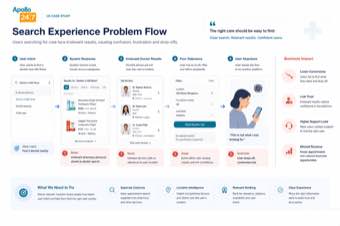
1
Search that understands what you need, not just what you type
We replaced a single generic search bar with popular specialties, recent searches, and AI-ranked doctor recommendations, so patients reach the right doctor in fewer taps and fewer dead-end results.
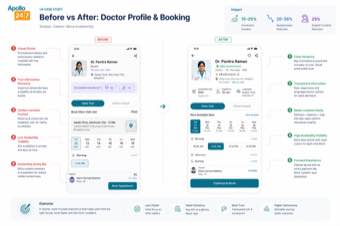
2
One profile, every trust signal upfront
The redesigned doctor profile surfaces verified badges, fees, experience, languages, and real-time slot availability together, replacing a cluttered layout with a clear hierarchy that shortens the way from profile to booked slot.
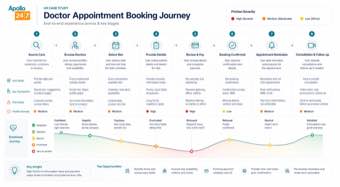
3
A booking journey patients can follow start to finish
Search, scheduling, payment, and confirmation now flow as one continuous journey with proactive reminders and follow-up care, closing the loop that used to end at a static confirmation screen.
IMPACT
What actually shifted

58%
Reduction in high-risk incidents (vs. prior year)

72%
Faster average intervention time

89%
Stakeholder satisfaction (students, staff & parents)

2.4x
More interventions before escalation
BEFORE
15.2% appointment conversion rate
41% of at-risk students identified early
48% follow-through completion on interventions
AFTER
19.3% appointment conversion rate
87% of at-risk students identified early
83% follow-through completion on interventions
The redesign has transformed the booking experience — making it simpler, more trustworthy and significantly more effective for our patients and our business.
Dr. Melissa Harper, Superintendent, Northfield School District
Curious how this could apply to your system?
REFLECTION
What I'd carry forward
What I'd do differently
I'd bring families into the co-design process from day one — parent visibility ended up being just as urgent as the counselor's detection problem, and we almost scoped the Parent & Guardian App as a 'later' phase instead of a launch priority.
What this taught me
Trust is the product. Everything else — the AI models, the dashboards, the alerts — is just a capability. The moment schools trusted the system enough to act on what it surfaced, the metrics moved.