
Bell the Bull | Detecting Risk Earlier, Acting with Confidence
Student safety signals were scattered across eight disconnected systems — leaving risk undetected until it was too late and too little to help.
Role
Lead UX Manager
Timeline
2-day design sprint · 2022
Team
3 Designers
2 Researchers
1 UX Writer
1 Product Manager
Primary metric
58% ↓ high-risk incidents
72% faster intervention

OVERVIEW
The snapshot
Challenge
Schools relied on 8+ disconnected systems for attendance, learning, communication, wearables, and behavior.
These systems didn't share data, making it harder to spot patterns early. As a result, 70% of at-risk cases went unidentified until it was too late, while student safety incidents cost districts an estimated $11B+ annually.
Approach
Led a 2-day, two-sprint mixed-method research engagement with 28 stakeholders, including administrators, counselors, teachers, and parents.
Used interviews, surveys, contextual inquiry, journey mapping, and competitive analysis to map the full detect-to-resolve lifecycle.
Result
Delivered an AI-powered student safety platform across admin, counselor, parent, and student experiences. Unified risk signals into one view, reducing high-risk incidents by 58% and cutting average intervention time from 2.6 days to 1h 24m.
HERO METRIC
58%
Reduction in high-risk incidents
PROBLEM
What was breaking
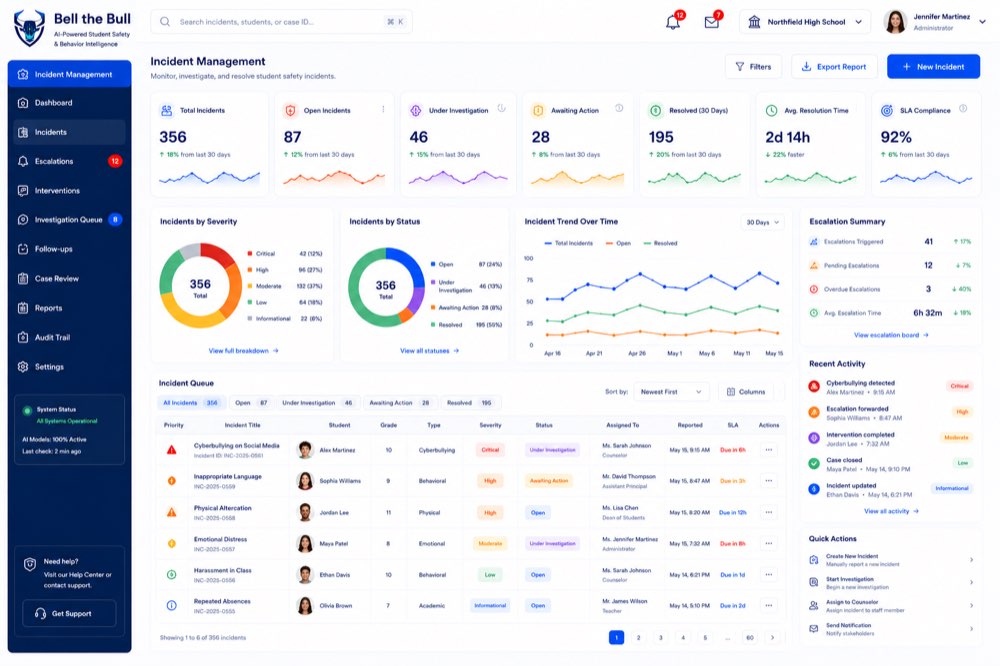
78% of staff checked 5+ different systems daily just to understand a single student's risk profile
Average of 2.6 days passed between the first risk signal and any intervention, with 63% of critical cases escalating before staff acted
68% of parents didn't know how to get help or who to contact when a concern arose
We're not blind to student struggles. We're blind to the full picture.
DISCOVERY
How I learned it
Kickoff & scope definition (Day 1 morning)
16 stakeholder interviews, 6 contextual inquiries & 87 survey responses (Day 1 afternoon)
Affinity mapping & theme synthesis across 4 key areas (Day 2 morning)
Findings validation & opportunity prioritization with stakeholders (Day 2 afternoon)
Signals are everywhere, but insight is nowhere - 78% of staff check more than five systems daily to understand a student
Found in stakeholder interviews & contextual inquiry (95% confidence)
Interventions happen too late to matter - 2.6 days average between first signal and intervention
Found in document review & journey mapping (90% confidence)
Staff are overwhelmed and lack actionable clarity - 72% feel overwhelmed by alerts
Found in document review & reporting process analysis
INSIGHTS
The moments things clicked
Signals are everywhere, but insight is nowhere
Risk signals exist across many systems but are fragmented and never correlated into a single view of a student's wellbeing.
Interventions happen too late to matter
Delays in detection and escalation - 2.6 days on average - reduce the effectiveness of support and let risk compound.
Manual reporting crowds out the time it's meant to protect
High workloads, alert fatigue (72% overwhelmed), and unclear ownership lead to stress and inconsistent follow-through.
STRATEGY
How I chose what to build
A compliance workflow so confusing, 1 in 3 users abandoned it mid-form.
A compliance workflow so confusing, 1 in 3 users abandoned it mid-form.
A compliance workflow so confusing, 1 in 3 users abandoned it mid-form.
A compliance workflow so confusing, 1 in 3 users abandoned it mid-form.
A compliance workflow so confusing, 1 in 3 users abandoned it mid-form.
A compliance workflow so confusing, 1 in 3 users abandoned it mid-form.
THE TRADE OFF
A compliance workflow so confusing, 1 in 3 users abandoned it mid-form.
SOLUTION
The final shape of things
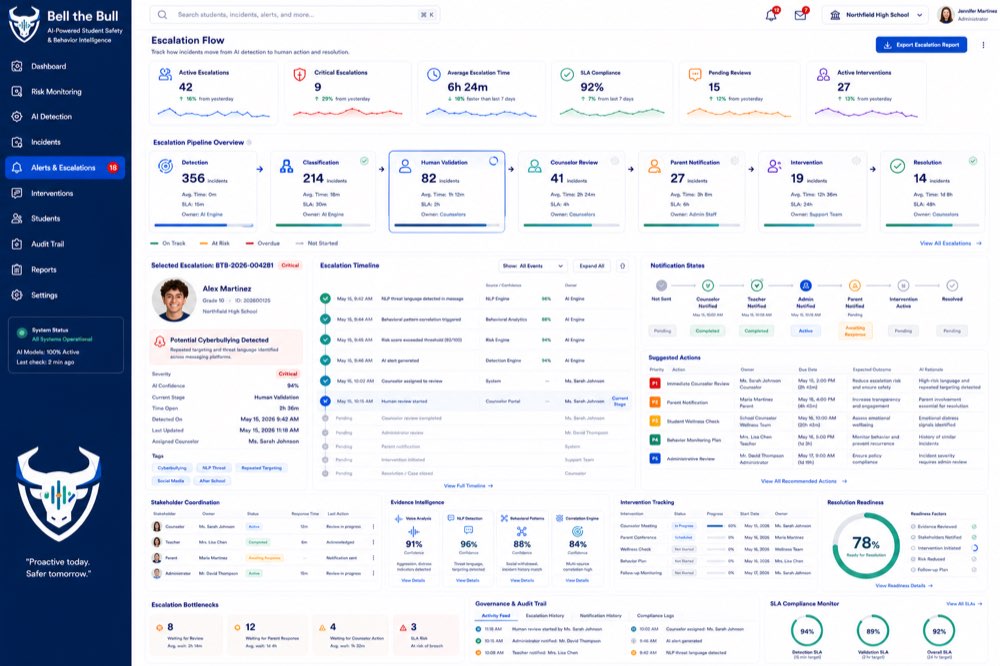
1
Escalation, not email chains
A structured, timed escalation pipeline routes every incident from AI detection through human validation, counselor review, and parent notification - cutting average escalation time and giving every stakeholder a clear next action.
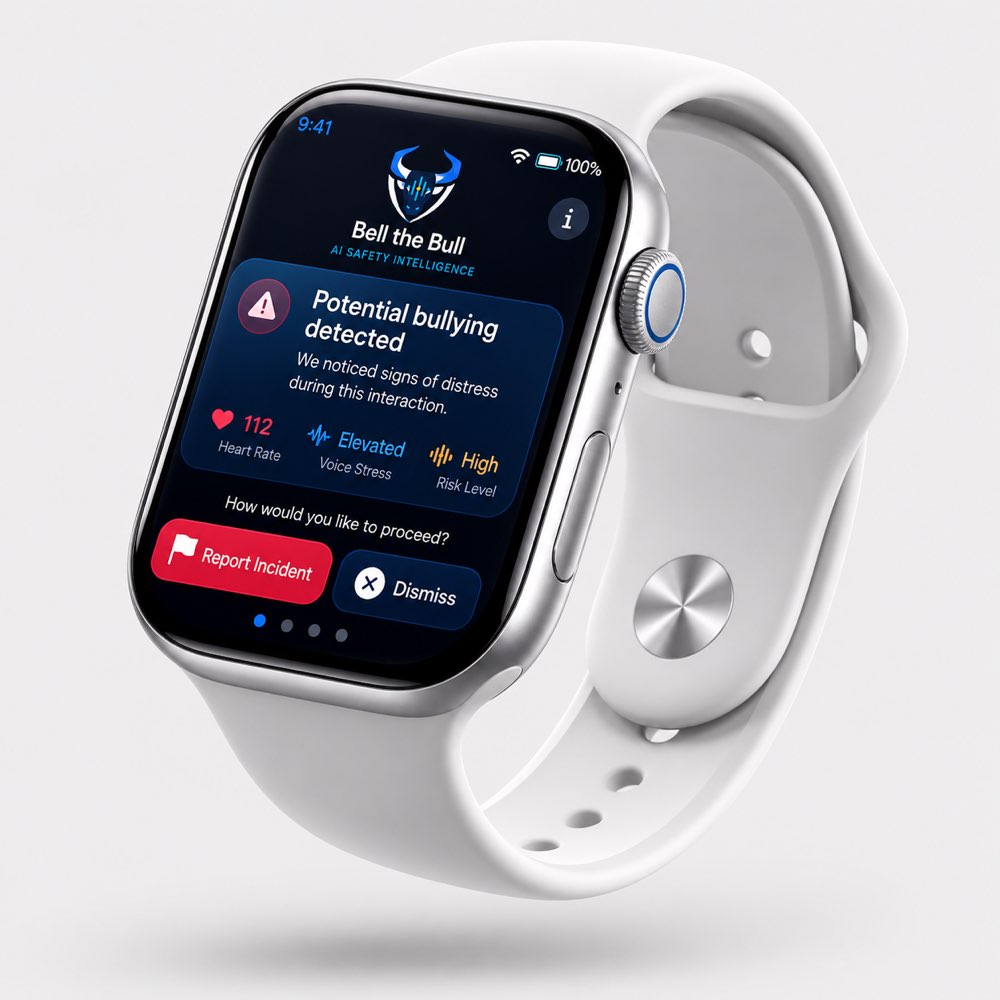
2
Signals caught on the wrist, not after the fact
Wearable check-ins surface potential distress in real time - heart rate, voice stress, and risk level - and let a student report an incident in one tap, closing the gap between a signal and a response.
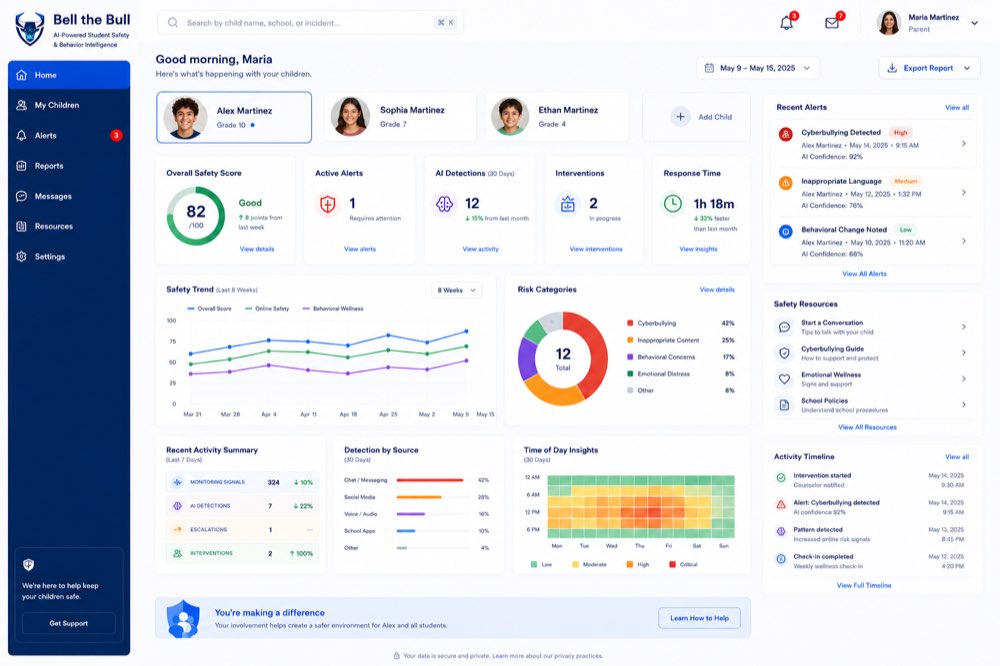
3
Parents see status, not silence
A dedicated parent portal shows safety score, active alerts, and intervention progress in real time, replacing the 68% of parents who previously didn't know how to get help.
IMPACT
What actually shifted

58%
Reduction in high-risk incidents (vs. prior year)

72%
Faster average intervention time
89%
Stakeholder satisfaction (students, staff & parents)

2.4x
More interventions before escalation
BEFORE
2.6 days average time from signal to intervention
41% of at-risk students identified early
48% follow-through completion on interventions
AFTER
1h 24m average time from signal to intervention
87% of at-risk students identified early
83% follow-through completion on interventions
REFLECTION
What I'd carry forward
What I'd do differently
I'd bring families into the co-design process from day one - parent visibility ended up being just as urgent as the counselor's detection problem, and we almost scoped the Parent & Guardian App as a 'later' phase instead of a launch priority.
What this taught me
Trust is the product. Everything else - the AI models, the dashboards, the alerts - is just a capability.
The moment schools trusted the system enough to act on what it surfaced, the metrics moved.