
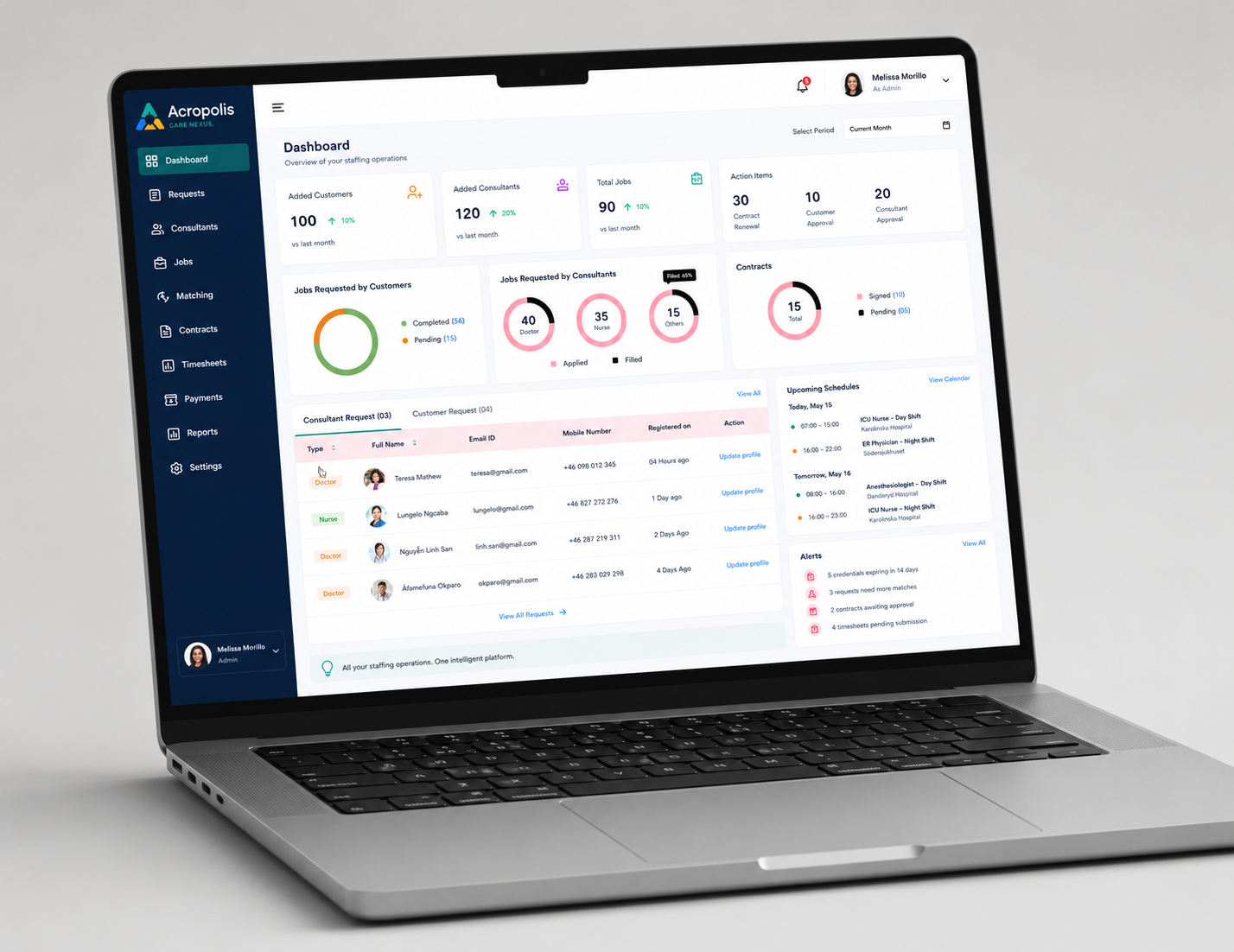
Acropolis Care Nexus | Intelligent Staffing, Better Matches, Better Care
Healthcare staffing was slowed by fragmented workflows and disconnected systems.
This led to delayed placements, higher costs, and greater risk.
Role
Lead UX Manager
Timeline
14 days · two design sprints · 2025
Team
4 Designers
2 Researchers
1 Product Manager
1 Data Scientist
1 Development Lead
Primary metric
58% ↓ time to fill
$4.8M annualized savings
OVERVIEW
The snapshot
Challenge
Hospitals, recruiters, and clinicians worked across 8+ disconnected systems just to fill a single shift, with credentialing alone adding 6.2 days per placement.
Approach
Led a 14-day, two-sprint mixed-method research and design engagement with 28 stakeholders across 12 hospitals and 6 staffing agencies.
Mapped the end-to-end staffing lifecycle to identify gaps and opportunities.
Result
Unified matching, credentialing, and scheduling in one AI-powered platform.
Cut time-to-fill from 8.7 to 3.6 days and increased fill rate from 69% to 92%.
HERO METRIC
58%
Faster time to fill critical shifts
PROBLEM
What was breaking
Credentialing alone averaged 6.2 days, the single biggest bottleneck to placement
Recruiters switched between 8+ systems, averaging 11.4 tool switches per placement
64% of hospital admins had no real-time visibility into placement status
When systems don't talk, people work harder. When people work harder, care suffers.
DISCOVERY
How I learned it
Kickoff & stakeholder alignment
28 stakeholder interviews across hospitals, recruiters & credentialing teams
Journey mapping & recruiter shadowing
Affinity synthesis & validation sessions
Credentialing is where good candidates go to die — slow, manual, different every time
Found in interviews with senior recruiters
Recruiters average 8.6 tools per placement, ranging 6–14 tools
Found in recruiter shadowing across 3 regions
59% of teams report missed or delayed information between recruiters and hospitals
Found in workflow observation across the SOC
INSIGHTS
The moments things clicked
Credentialing is the biggest bottleneck
Manual, repetitive verification steps create days of delay before a clinician can be placed.
Recruiters juggle too many tools and tabs
Recruiters switch between 8+ systems to complete a single placement, with heavy duplicate data entry.
Analysts lack confidence in prioritization
Leaders don't have clear status, risk visibility, or a single source of truth into placements.
STRATEGY
How I chose what to build
A compliance workflow so confusing, 1 in 3 users abandoned it mid-form.
A compliance workflow so confusing, 1 in 3 users abandoned it mid-form.
A compliance workflow so confusing, 1 in 3 users abandoned it mid-form.
A compliance workflow so confusing, 1 in 3 users abandoned it mid-form.
A compliance workflow so confusing, 1 in 3 users abandoned it mid-form.
A compliance workflow so confusing, 1 in 3 users abandoned it mid-form.
THE TRADE OFF
A compliance workflow so confusing, 1 in 3 users abandoned it mid-form.
SOLUTION
The final shape of things
1
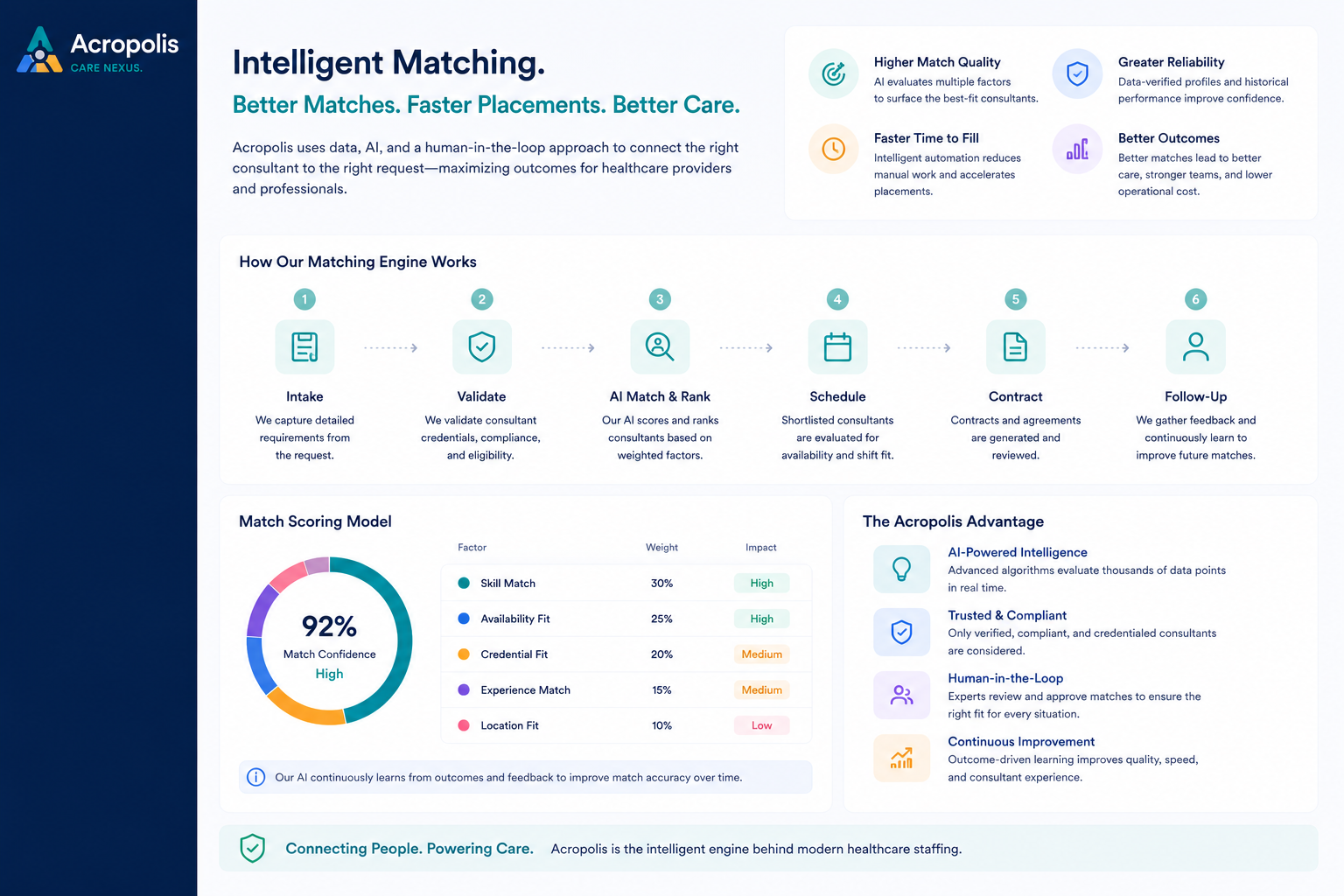
Matches ranked by more than a resume
The matching engine weighs skills, availability, credentials, experience, and location.
Recruiters can see why each candidate ranked where they did.
2
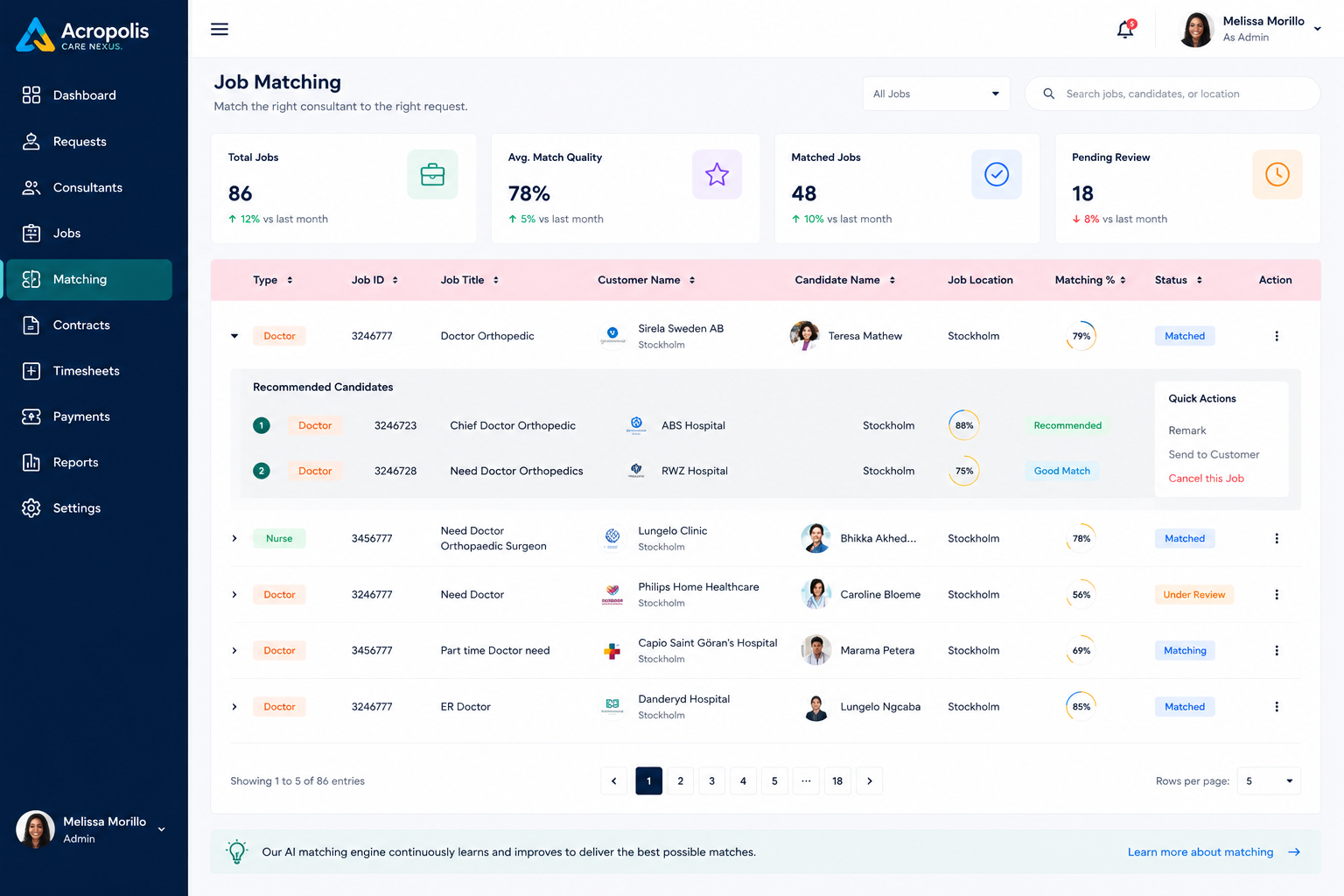
One queue, not eight systems
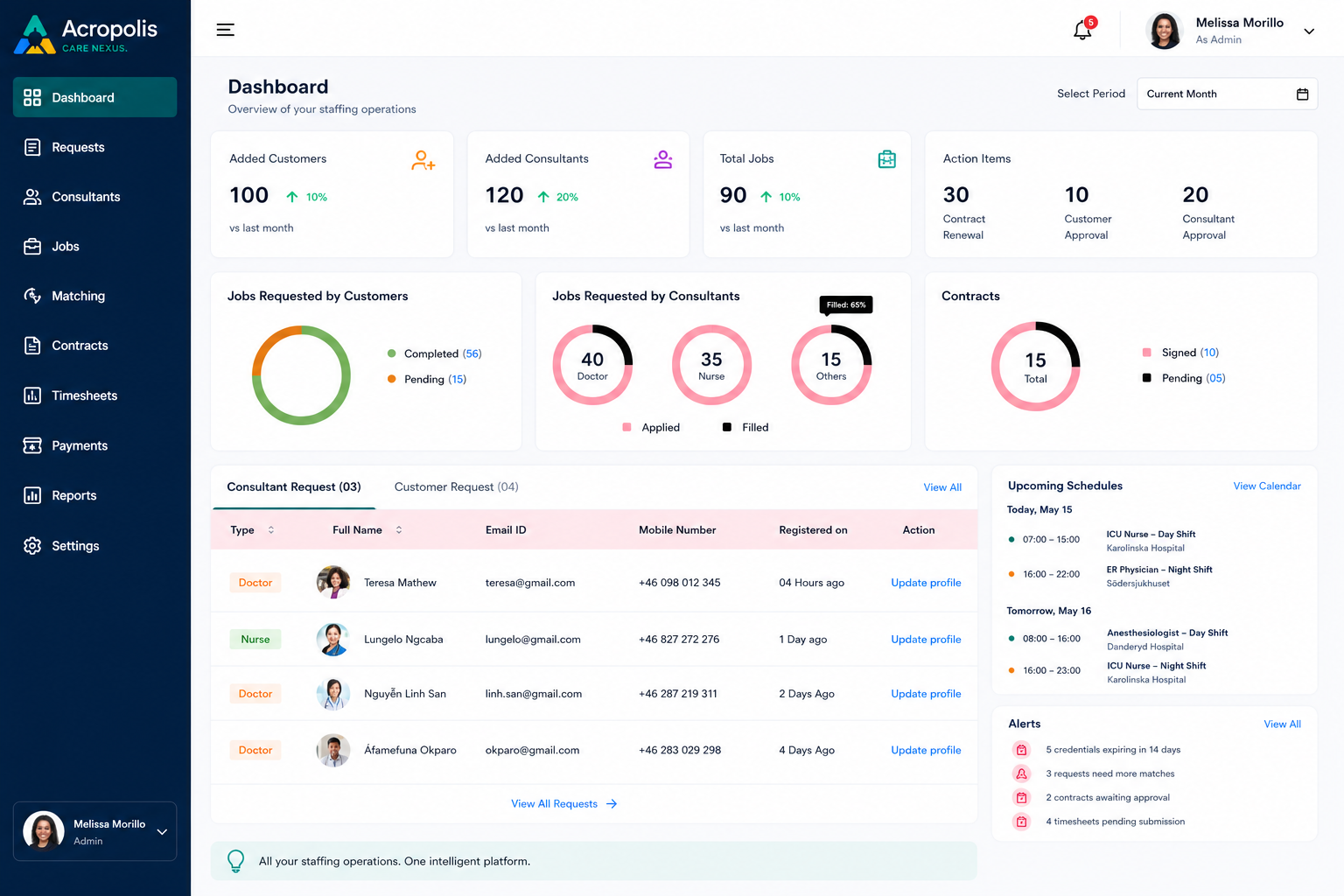
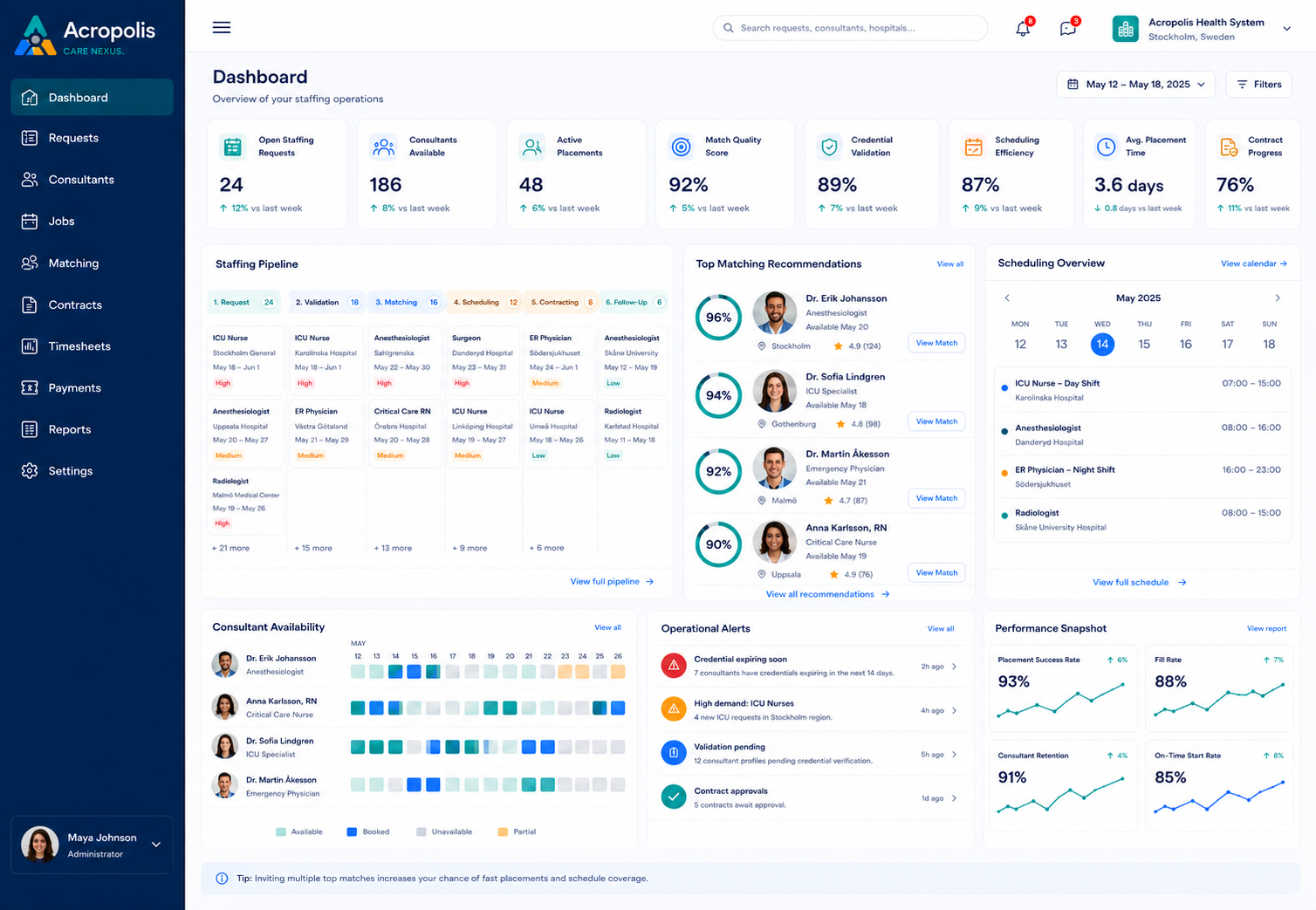
Every open request, its top matches, and its status now live in a single queue recruiters can act on directly.
3
Hospitals see status, not just a request form
Hospital admins get real-time visibility into fill rate, credentialing status, and consultant availability — no more waiting on an email.
IMPACT
What actually shifted

58%
Time to fill (8.7 → 3.6 days)

92%
Fill rate (from 69%)
31%
Cost savings, annualized

140%
Recruiter productivity (2.4x)
BEFORE
8.7 days average time to fill
6.2 days average credentialing time
18.6 manual touches per placement
AFTER
3.6 days average time to fill
2.1 days average credentialing time
6.2 manual touches per placement
Acropolis Care Nexus has transformed the way we staff our facilities. We're filling more shifts, faster, with the right people — and our teams can finally focus on what matters most: our patients.
Lerrisha Thomas, Chief Nursing Officer, St Ann's nursing hospital
REFLECTION
What I'd carry forward
What I'd do differently
I'd bring hospital admins into the co-design sessions earlier.
Their visibility problem turned out to be just as important as the recruiter's matching problem, and we nearly under-scoped the analytics dashboard because of it.
What this taught me
The problem wasn't effort. It was fragmentation.
Every team we spoke with was already working hard. What they lacked was one platform that worked for everyone. Fixing the system, not any single screen, is what moved the metrics.